The Shed

The Shed
The Shed
Showing posts with label shed. Show all posts

Friday, October 5, 2012

FARM GIRLS CORNER - The baby Boules

Hi there turnip lovers, its me Farm Girl and you know me by now. I help out around the Shed and Garden, and assist Uncle Mac when he needs it. Today I collaborated with him on a "Hay Stack Compression Test" apparently gathering valuable information to help us prepare for the Winter months. It seemed a lot like the other hay compression exercises we perform all year long, but I digress.

F.G. AS EVER WAS


The Boulle D'or or yellow turnip patch is developing nicely, as you might expect, since the sow date on  August 17.

LUSH, THICK GREENS

Little turnips have formed to the point that they will switch into over drive very shortly, and grow visibly almost by the day.

AIN'T HE CUTE?

But you are really here to check on Mr. Big, are you not? Well here he is. Mr. Big and his kin suffered a devastating attack of young caterpillars but sprays and hand picking seem to have got them all over the hump.

MR. BIG AT HOME
Sticking with his "inch a week" program Mr. Big is now 20" in circumference, which means we have a whole lot o' baga going on.

I'M READY FOR MY CLOSE UP NOW, FARM GIRL
This fine fat fellow has at least three weeks before a serious frost event should occur, so we don't expect to be inviting him for dinner anytime soon. In fact, we're thinking of keeping him hanging around until Thanksgiving, if things should work out that way.

I think we've gotten to the root of the matter for now, so until next week, thanks for stopping by!


Tuesday, July 10, 2012

FARM GIRL'S CORNER - Fall cabbage

Hi! Farm Girl here! I help out a lot in the garden and around the shed and what not. Today I almost helped Uncle Mac a bit more than necessary. There I was, plucking a few stray weeds from the corn patch when I here him bellowing:

"Farm Girl!" Have you seen my pole?"

Good grief, I thought, you mean since breakfast? The old boy's been into the fenugreek again. But when I looked around I saw that he was holding his tackle box and net and looking puzzled.

"In the ammo room, Mac," I told him, "Aggy put it there."

And off he went to drown a few worms.

But today I'd like to tell about the fall crop we're about to put in, green cabbage. A bit early, you may be thinking but no, not in zone 5 where our garden is located.

To grow fall cabbages successfully you of course, need a place to plant them. Cabbages make a great follow up crop in a bed where radishes have been, or peas but beware planting after cauliflower, broccoli or kale; or any other veggies of the brassica genus. Members of this group share the same nutritional requirements and the second crop will suffer as a result.


We selected the heavy duty "Megaton" cabbage, a giant cabbage which happens to be extraordinarily tasty, and which stores well.

Megaton is a widely available variety, our seed happens to come from the Jung Seed company.

As it happens we let a raised bed lie fallow (no spring crop) until it was Megaton time. All we did in spring was turn the bed, work in a lot of compost, some wood ashes and a goodly amount of bone meal. (Cabbages are heavy feeders and particularly fond of phosphorus, hence the bone meal boost.)

We gave the bed a shallow turn over and raking every few weeks to knock down the weeds but otherwise left it alone.

Now, at planting time, we worked in a bit more compost and directly sowed the seeds into the bed. Megaton is a big, rambunctious cabbage and we like to give each one a full square yard in which to grow. As these huge brassicas can top 20 lbs in weight, this is not a waste of growing space.

It is important to mulch the seedlings as soon as they are big enough to tolerate it, preferably with sifted compost but if not, with grass clippings. They will benefit enormously from the cooling and water retention that mulch provides during the hot spells that are bound to occur in August and September.

Megaton cabbages take 90 to 100 days to mature after germination, be sure to water regularly and deeply, they are thirsty veggies.

A side dressing of "Superphosphate" or the like would not be amiss halfway through the growth cycle, particularly if you are trying for an eye popping, blue ribbon giant.

And that's about it for...What the heck??


Leatherface! NO!! You may NOT make your "world famous" stuffed cabbages! You remember all the trouble that caused the last time! Take that child back to wherever you found him right this minute!

Now he'll mope for a week.

Anyway that's the story with fall cabbages here at Farm Girl's Corner! As always, thanks for stopping by!   


Saturday, June 30, 2012

Garage and rummage sales yield unusual gardening tools


Hi its Aunt Agnes agin' stoppin' by with some quick info!

Ya know, nobody ever uses "Uncle Mac" and "genious" in the same sentence but the man occasionally demonstrates a low form of animal cunning. The sort you see in salmon fer instance, when somehow they return unerringly to their home rivers when its spawnin' time, or in the humble woodchuck who never fails to find the right hole. I understand that the latter skill set is actually beyond Uncle Mac when he's in his cups but of course that's just hear say.

But what...

[ Editors note: Just making the observation that a man who can manipulate space-time without making fatal errors cannot be a complete idiot! ]

[ Farm Girl's rebuttal to the editor's unwarranted intrusion into Aggy's post: "Wanna bet?" ]   

Erm? Are ya'll done buttin' in?

Anyway I wanted to tell you about the unusual but useful and CHEAP tools Mac brought home from the rummage sale t'other day.


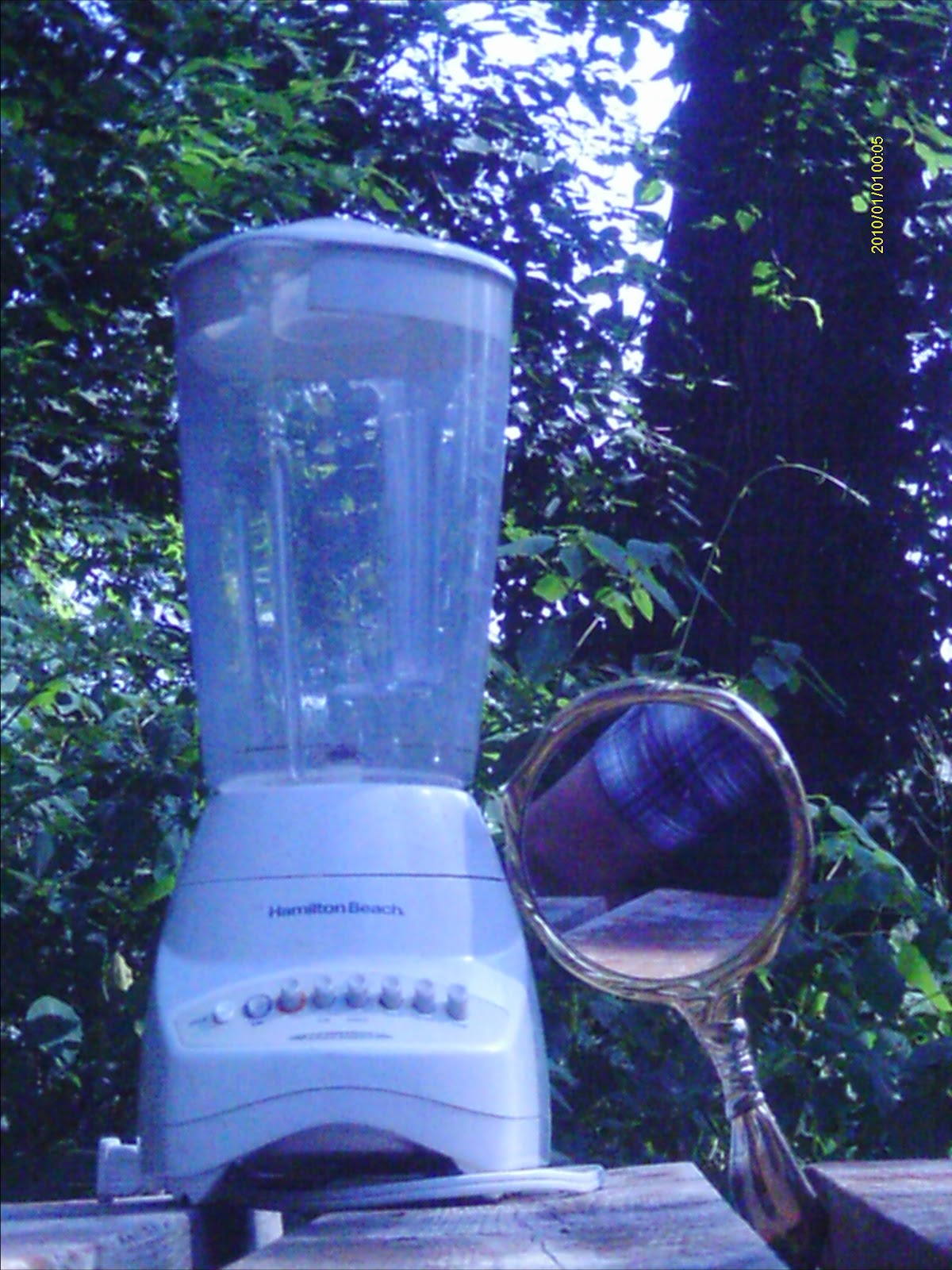
Oh I know whatcher thinkin'! Its a blender and a Granny mirror! What in the wide world of sports are we gonna do with those?

Well, first of all, we are gonna put dryed egg shells in the blender and reduce them to powder, along with just a wee bit of epsom salt. This, if we are unimaginative makes a nice side dressing for plants that we wish to dress, sideways.

But, if we chuck in room temperature water we can make a nice calcium magnesium shake to pour right on the mulch covering our plants roots! 

Of course we have to shake the hell out of the container to make sure the calcium does not precipatate to the bottom, y'all know how intractable calcium can be.

And then Uncle Mac makes us all pina coladas in that blender! They are crunchy and taste like a dose of salts but hey, there's an s-load of rum and what might actually be coconut in there, lets not offend the old buzzard.

"Did you clean this blender before you mixed drinks?", Farm Girl asked one time.

"Course I did."  said the antique lyin' sack of organic fertilzer.

That leaves the Granny mirror. 

What's on yourn squash? Squash bugs!


Where do they lay eggs? Under the leaves.


How do y'all find these nasty bastids? Y'all look under the leaves.

What is the easiest way on both the gardener and the plant to do so? With a mirror.

Well there y'all have it, Uncle Mac blunders into something useful, make of it what ya will.

This is Aunt Aggy, Have a festive 4th of July and thanks for readin'!


Sunday, June 24, 2012

FARM GIRL'S CORNER - The seediness of Uncle Mac, Part 2

Hi there, you know me its Farm Girl, I help out (as in, do most of the mundane gardening work) around the Shed and in the garden and so on. You know how seedy a guy Uncle Mac is, seems he can't find enough places to deposit seed. But I digress...


Every once in a while in the course of what we like to call "doing research" ie., "making shit up" we come across a factoid or blog or website that deserves promoting. And we found one, and we need to give them all kinds of credit and a plug as well. But first, a picture, which we have determined is not worth a thousand words, but only 914. But you know, close enough.


What is THIS, you may ask, and who can blame you?
Its called "Petrowski's turnip" named after the famous Petrowski and it has the distinction of being a quick growing biggish yellow turnip that tastes nothing like a white turnip, not that there's anything wrong with that, of course.

You can get it from the folks at "Real Seeds" just by clicking on the link. We'll be buying a few packets tomorrow, still plenty of time for a fall crop of these beauties in our zone. (5 - 6) 

But that turnip, interesting as it is only scratches the surface. This company has many heirloom seeds, (in fact, they have no hybrids at all), many of which will be new to US gardeners.

This includes a white turnip big as a dinner plate but let's not hold that against them.


Real Seeds also tells you how to save your own seeds for next years planting, and people, if you take nothing seriously from our blog listen to this, we all have to learn how to do this and we need to learn fast. Monsanto is coming. And it ain't gonna be pretty. (See related article HERE)

We have saved squash, cuke, tomato and pepper seeds here at the Shed for some time but now we are going to branch out. Use Real Seeds info as a jumping off point and you can do so too. Hey, its fun and you can swap with your friends!

And that's it for Farm Girl's Corner, enjoy those yellow turnips and thanks a bunch for stopping by!   

Thursday, June 21, 2012

THE CHILDRENS HOUR WITH LEATHERFACE - The squash bug

Hi boys and girls its your favorite babysitter and all around cut - up, Leatherface! Boy its going to be a hot one today, isn't it? We'll have cold cuts for lunch! Who doesn't like a nice hand sammige with lettuce and mayo and some cool iced tea? Well gosh darn it we all do!


KINDLY OLD LEATHERPUSS

But today I have to tell you about one of the most insidious, clandestine, persistent, nastiest, butt-ugly destructive scourges ever to plague any garden, with or without a garden shed. 

What Billy? Aunt Agnes? Ho ho, no, close but no cigar. No, we are talking about this little ugly gray insect right here.
 
ANASA TRISTIS, FAMILY COREIDAE; THE SQUASH BUG


Ugly little spud, is it not? And what total havoc this invader creates in the garden. Lets take a quick look. 


Do you like your squash vines to look like this?


Or, like this?


Tough choice, isn't it? Would you like pumpkin pie made from these? 


Or, from one like this?


The problem starts in the fall, when the adult bugs burrough into the garden debris and over winter there. A quick, early and very hard freeze is an ally at this point, and will kill many of them, reducing the problem the following year. A mildf winter however leads to low bug mortality and a correspondingly quick and voluminous start in spring. 

Squash bugs become active in june, just about the time the squash are developing and from that point on, it is all about the squash. Your squash. 

Squash bugs are insect vampires, plunging their proboscis into every vein on the leaves and stems of the plants and eventually into the fruiting bodies themselves. They can collapse the vines and leaves, killing the plant outright and causing the squash to rot.


They have unprotected squash bug sex right on the vines and deposit their distinctive egg cases directly on the undeside of the leaves. Other generations replicate and before long, the squash bugs are out of control and you are looking at a dissapointing crop, if any at all.

WHAT TO DO

Vigilance:

Watch for these little creeps beginning in early June, on the leaves of your squashes, particularly underneath, and by the very base of the plant. Kill every single one you see, and crush every single egg. Start early before the hordes multiply and you have a chance to avoid damage. Spray the vines and leaves with any deterrent containing pyrethrine, these are specially effective vs. squash bugs. Be relentless; a few lax days and you could have squash bugs up the gagootz.

Know when you are beaten:

If you had a bad infestation last year and a mild winter, you might be overwhelmed no matter how fiercely you battle Anasa tristis. Do not hesitate. Get a hot fire going, perhaps in a 55 gallon drum, rip up the vines, squash, bugs, eggs and all and consign them to the flames. Do NOT put unburned squash vines into your compost! The ashes, of course, will be fine.

Toss in all mulch, ground litter etc. where other bugs can be hiding.

This may violate local ordinances; in our view here at the Shed we have an obligation to violate bad law. But follow your conscience on this one. 

If you cannot bring yourself to burn the vines and litter, fill the largest garbage bags you can get with the debris, spray in generous portions of Raid or the like, twist the bag tightly closed with a length of wire and pliers, and give the spoils to Mr. Garbage Man.

Don't mulch:

Heresy I know. We mulch everything in our garden, but not when battling squash bugs. It only gives them a breeding ground and a safe haven. Unmulched plants are much easier to inspect and the bugs easier to catch and kill. Sacrifice sound gardening practice for a season or two to deal with these interlopers, it is worth it in the long haul.

Fall clean up:

Scrape the garden clean, all old plants, all mulch, all fallen leaves, grass clumps; in short anything that could provide shelter for these critters overwinter. Pile it up, and drop a match.  Its good to clean the garden thoroughly in the fall anyway but now you are on a mission!

It is discouraging to have squash bugs show up and steal your prized crops from under your very nose, but they can be dealt with, although it is never easy. Now get outside and check those leaves!

That's it for this segment of the Children's Hour, thank you for stopping by!


Sunday, June 17, 2012

SOMETHING DEAD FROM THE SHED - Meganeueropsis permiana

Hello again everybody Its me, Jack, back from a trip to me old haunts in White Chapel. I've a smile on my face, a song in my heart, blood stains on my neck tie and surgical steel in my carryall.

A man has to touch base with his roots, from time to time.


NOT A DRAGONFLY BUT A REAL FLAME BELCHING FLYING DRAGON - ITS A LONG STORY...
Today on "Something Dead from the Shed" we'll be touching on the subject of giant dragonflies. No, not just a big bug from the back yard, but specimens larger than some surveillance drones. (Would have been hard times for Jackie if the coppers had drones in their bag o' tricks back in 1888, hey?)

We actually had a pair of these creatures here in the garden for about 3 - 4 minutes and as a group you can't find one that's any deader than the Meganeuropta so what better subject for my little essay?


MEG

As for the pair we had here momentarily, Mac had taken a day trip to the Carboniferous and came back with a great whacking box that was making suspicious rattling noises. He opened it up and out popped a pair of dragonflies, wings as wide as your arm is long! They flapped around awkwardly for about twenty seconds before auguring into the sweet corn like economy passenger jets into a Florida swamp.

"Mac! You silly bastid they can't breath!" I remember Farm Girl scolding the old coot, "The oxygen content was over 40% higher back when they were around! You take them back right now!"

"Arrgghh", Mac replied "They're bugs! Let 'em flop a bit we can add them to the compost."

"You..." said Farm Girl, "take them back now or you'll be polishin' your own dibble until the next ice age!"

The argument must have struck home because Mac had the feebly wriggling insects back in the box before you could say "unpolished dibble" which really is relatively easy to say. He disappeared with the "pop" that announces wormhole manipulation and was back five minutes later with an empty box, a bloody thumb and a surly manner.

"Bastid bit me. There's gratitude for ya!" 

A nasty infection ensued of course, nothing screws with the immune system like 300,000,000 year old bacteria. But eventually he healed right enough, all digits intact and only a nasty scar and one more thing to grumble about to show that damage had ever been done.

But enough Shed lore! Lets talk Meganeuropta!

*******************************************************************

When enormous dragonflies ruled the sky:

Life was never easy for small amphibians or average sized flying insects during the late Carboniferous and early Permian periods of the Paleozoic Era. As though the day to day requirement to feed and reproduce were not enough to worry about, the diminutive amphibian had to avoid hungry fishes when in the water, and apex predators like the therapsids (Titanophoneus as just one example) and pelycosaurs (Dimetrodon and kin) when on land. Large, hungry amphibians like Sclerocephalus were a danger whichever environment the tiny creature happened to occupy.

You would think that would be enough to contend with, and since pterosaurs were millions of years in the future as were predatory birds like herons, hawks and pelicans the little creature would be safe from above.

Not so. For, hovering aloft like the Apache attack helicopters they resemble were the gigantic dragonflies Meganeuropsis permiana.

Leave the fly swatter in the closet:

Probably the largest flying insect that ever lived, fossils of Meganeuropsis permiana have been discovered that have a wing span of just under 30 inches and a total body length of 17 inches. These were the largest creatures flying in the Carboniferous and Permian skies and like their smaller close relatives the modern dragonflies were voracious predators. Or perhaps more accurately, even more so.

The food required to produce the energy to keep this huge body aloft must have kept Meganeuropsis perpetually on the hunt. Modern dragonflies will attack tiny tadpoles and newly hatched fry; we can easily envision Meganeuropsis swooping down on anything up to chipmunk size that came to its attention. And of course, anything flying that was smaller than Meganeuropsis was fair game.

Raising a lot of questions:

Today there are no flying insects even close to the size of this ancient predator, for which we should probably be thankful. There is a school of thought that says that this creature should not have been able to fly at all.

The answer to how it did so lies more in the geography, climate and atmosphere of the Carboniferous and Permian periods than in the morphology of the huge insect itself. To simplify enormously; during most of the Carboniferous and Permian periods there existed one super continent, Pangaea, containing almost all of the earths land mass. An explosion of flora, all utilizing the photosynthetic process produced immense amounts of oxygen while binding enormous quantities of carbon dioxide. Over time this actually shifted the proportions of the earth’s gases.

Today, our atmosphere contains about 21% oxygen. It is estimated that Carboniferous-Permian atmospheres contained at least 30% and possibly as much as 35% oxygen, with a corresponding dip in the amount of free carbon dioxide. This, so the theory goes, permitted Meganeuropsis and its kin to breath efficiently, even though they do so through trachea and not through lungs and a circulatory system as we do. This would have kept the creatures oxygenated enough to fly.

Why did they go extinct?

On one level, this question is easily answered. The end of the Permian period was marked by one of the greatest mass extinctions ever known on our planet. Nearly everything that lived, died. That Meganeuropsis was among the casualties is no surprise. The deeper question of what caused the P/T extinction is a subject for intense debate, although once again it seems that massive impact from an extraterrestrial body may be to blame.

Whatever triggered the event of one fact we can be certain. The oxygen level of earths atmosphere, either as a by product of the extinction event itself or by some other mechanism that we do not as yet understand dropped precipitously. This alone would have sealed the fate of the great dragonflies forever.


And that's about that for today's Shedly dose of big bugs. Your pal Jack signing off; thanks for visiting us at "Something Dead from the Shed!"

[Editors note: Not so fast! The University of Arizona did an interesting experiment in which they raised modern dragonflies in an atmosphere approximating that which prevailed in the Carboniferous - early Permian. The result in a single generation was an average increase in size and weight of fifteen percent per dragonfly. 

Next time you are targeting that medium sized buzzing thing circling over your garden, before you squeeze the trigger make certain its a government drone you are ranging in on, and not some innocent escapee from UA!]


WELL NO THEY DIDN'T GET THAT BIG AT UA, BUT JUST GIVE THEM TIME!


Saturday, April 14, 2012

CRITTERS WE'D LIKE TO SEE IN THE SHED

Looks like old Leatherpuss has been telling you folks how to deal with pest animals amidst the veggies. Looks like he's fixin' to drag it out, one critter at a time, maybe get 5 -6 more posts out of it. This is what I get for letting just anybody wander by the shed. 

I'll deal with those pests in one paragraph. Have pests? Build a fence. Have big pests? Build a bigger fence! Do the pests climb the fence? Electrify the fence, and if none of that is effective, shoot the pest!

There, wasn't that easy? Wait until you see the multi page epic Leathermug turns it into.

But there are some critters that you definitely want hanging around the shed, wolves and the like although opinions vary on that. This endearing little fellow on the left is one such, and folks in the Southwest probably know him well.

Those who do not, meet Bassariscus astutus, also known as the ring-tailed cat or miner's cat. Ring-tails are of course not cats at all but are procyonids, which means they are closely related to raccoons as their striped bushy tails

might lead one to suspect. They are tiny creatures compared to raccoons, their body size somewhere between that of a large grey squirrel and a small domestic cat. They also lack the boldness and sheer gall of their raccoon cousins, are almost entirely nocturnal and tend to shy away from humans and their domestic livestock and pets.

However, their essentially mild dispositions and extremely curious nature make them relatively easy to befriend if obtained young, and even older ones will acclimate well to people if treated properly. They make wonderful, entertaining pets once they get over their 

initial shyness.

Well, ok, but why would we want one or two living in the garden shed? Because they eat the very things we want to get rid of, bugs, spiders and rodents of all varieties. They do a much better job than the average fat and lazy house tabby, and can go places where wolves simply do not fit.

The miners and ranchers who moved into the old west recognized this fact and made haste to make friends with the little creatures, going so far as to build them houses from packing crates, placed near enough to the stove to provide warmth. The nickname "Miner's Cat" gives some indication of the prevalence of the practice.

If there is one downside to inviting ring-tails in, it is that their curiosity and climbing skills mean that they are constantly into everything. But hey! It's the garden shed, do we really care?

 All right we have the Southwest covered very nicely, what do we have for Northeastern sheds? We are way out of ring-tailed cat territory and they wouldn't like it up here in the north, anyway they prefer rocky desert environs.

Fortunately we have ermines, or stoats, or big old weasels if you prefer, and if there is one thing that ermines like better than killing and eating a rodent, its killing and eating a bigger one. They are even better at it than the ring-tails.

Stoat, ermine or weasel the scientific name is Mustela erminea. Ermine is a stoat in its fine white winter coat, summer 

garb is brown on top and white beneath.

Only 12" long not counting tail the stoat is ideally designed to go into rodent burrows after its prey. It favors mice, voles, rats, chipmunks and will kill squirrels and rabbits larger than itself when need be.

Unlike our little ring tail-friend, stoats are not cuddly pets. A few have probably been tamed from time to time but nipped fingers, which after all look like a plump and juicy mouse, are always a possibility.

Stoats go where the rodents are, and that can well be sheds and barns. They do an excellent 

 job of controlling these offensive and crop destroying vermin and are therefore always welcome at Uncle Mac's.


Vida Guerra's anti-rodent potential at this time is neither known nor relevant, but we can't help but feel that there is room for her in the shed.

Perhaps as a roving reporter, interviewing other shed dwellers, or perhaps the critters, or why not? Perhaps she can interview the vegetables themselves.

"This is Vida Guerra live from Uncle Mac's corn patch, where today we'll be interviewing a Country Gentleman corn stalk. Pardon me, Mr. Stalk, but could I have a few moments of your time?"

"I'm all ears, Vida."

"No, really, I need a new agent. This crap has to stop!"


Vida, really, wearing actual ermine hides where Mrs. Stoat can see them!

You take those off right now young lady!


Well OK! That wraps this extravaganza up for now, thanks for visiting Uncle Mac's garden Shed!

Sunday, March 25, 2012

FARM GIRL'S CORNER - Swiss chard

  FARM GIRL AND FRIEND

Hi! I'm Farm Girl and I help Uncle Mac around the shed, and out in the garden and things like that. This morning for example, it was a little chilly outside so I helped him warm his dibble before we went outdoors to work. It is amazing what a feller, even an old geezer like Mac, can accomplish with a well warmed dibble!

But what today's Corner is all about is Swiss Chard and why it's such a great veggie to grow!

Everyone looks forward to greens in springtime, they are usually some of the first crops available. Kale, beet and turnip greens, tender spinach, all are wonderful straight from the plot and into the pot. The only problem is, once you have cut them, you have seen the last of them until the fall crop comes in. They will not grow back.


Not so with Swiss Chard. This cousin of the beet will produce tender, buttery leaves and flavorful stalks from late spring through the first hard frost if properly tended.

As with most vegetables chard produces best when the bed is partially prepared during the preceding years fall clean up. Chard produces a broad and deep root system, so when digging the prospective bed, double digging is beneficial. Take the opportunity to add large quantities of compost and other organic matter, chard thrives on loose, well drained soil. Chard is one of those few vegetables that does not require full sun to flourish, six hours daily is adequate.


Two weeks before the final frost date is a fine time to plant, so long as the beds have thawed and drained. Otherwise wait another week or two. Soaking the seeds overnight will shorten germination time, which can occur in 7 to 14 days depending on the weather.

Here at the shed we like to give the chard bed a quick dig, adding sifted compost and then raking it smooth.  We then add a 1 1/2" to 2" layer of sifted compost made by the hot process method which has killed the weed seeds, and rake that smooth as well. Next, wherever we want a chard plant (About 5" from center to center) we scoop out a cup sized divot from the compost layer and fill it with fine, unfertilized potting soil. We plant 3 to 4 chard seeds in each circle of potting soil, just about 1/2" deep, and gently pat the soil flat.

You may be thinking that's a lot of work for a small chard patch but really, it pays off. The potting soil is sterilized, free of weed and other seeds and you therefore know that whatever sprouts in it is chard. The compost layer is likewise 98% free of weed seeds and suppresses the growth of most weeds coming from the dirt layer below. Initial weeding is virtually eliminated, a mulch layer is prepositioned and all the gardener has to do is thin the chard plants to one plant per potting soil circle.

Some outer leaves should be ready to harvest in 40 to 45 days from germination, always leave the smaller, inner leaves and chard will continue to produce in most planting zones right up until the first hard frost.

Chard needs regular watering but should require no nutrients other than the compost already provided, it is a relatively light feeder.

Swiss chard is as delightful to look at as it it tasty on the table, and can be used to add color and eye appeal to the garden. Different colors can be placed in small patches at strategic locations to create an unusual and pleasing effect.

While most traditional chards like Fordhook Giant and Lucullus feature dark green leaves on white stalks, as in the first picture, there are also magenta varieties...


There are golden varieties...


"Bright Lights" mixes all colors of chard together in one packet...


Botanical gardens find Swiss Chard so colorful they sometimes include it in ornamental beds!

But chard is primarily for eating and can be used raw in salads, stir fried, boiled, steamed and prepared many ways using a plethora of recipes. As an extra bonus chard happens to be one of the most nutritional vegetables available, packed with vitamins, minerals and nutrients.

Chard seeds are available in any garden supply store, or from any of the seed companies, or even at your supermarket in the seed rack in the produce section. Why not add this tasty, nutritious, eye pleasing easy to grow green vegetable to your garden plot? You will be glad you did! 

That wraps up today's Farm Girl's Corner; as always, thanks for stopping by!  


Sunday, March 18, 2012

FARM GIRL'S CORNER - Why bust your onions?

FARM GIRL

Hi! I'm Farm Girl, I help Uncle Mac whenever there is work to be done, out in the garden and around the shed and that kind of thing. But some times he just wants to play! Why just this mornin' he said to me:

"Hey! Farm Girl!"

"Yes Mac?" I said.

"Lets play the farm tool game! I'll be a rake, and you can be a hoe!

"Well that's sounds nice", I said.

What was I thinkin'? It was fixin' to rain but still. Sometimes I wish he'd go stay at Wooly Acres where old goats are always welcome.

But today I'm here to talk about growing onions.

Have onions been problematic for you? You are not alone. There are lots of gardening folks who grow onions when they plant them, but they just seem so much smaller than expected. And that could be because they are simply missing a few essential onioning facts.

Usually I don't plug one particular company here at the Corner but that is more of a guideline than a rule. When someone goes the extra mile, we like to tell you about it!

http://www.dixondalefarms.com/ is one such outfit. They specialize in onions and relatives (like garlic, not their grandmas) and have done so for 100 years. They tell you things about onion culture that are not generally known; things that can help you grow a successful onion patch. 

And they offer a nice selection of onions aiming for success throughout the USA.

If you haven't already bought your onion plants why not click on over to their site and take a look? You have nothing to lose, and alliums to gain!

As always thank you for stopping by at Farm Girls Corner!

(And if you see Uncle Mac tell him where he can put his rake next time it rains!)

Friday, December 30, 2011

To shed, or not to shed?

BASIC SHED

You are wondering if you need a shed to compliment the new vegetable garden. Strictly speaking, no, you can get along without one. The plant food, sprayer, trowel and weeder can bide their time in the cellar, it isn’t too inconvenient to bring them back as forth as needed. The same is true for the baskets, sunscreen, insect repellent, seeds, pots, transplants, trellising material and stakes. And as for the hoes, rakes, shovels, spades and pickaxes? They’ve been content in the garage up until now; why not permit them to remain there along with the ice melt, lawnmower and croquet set?

Of course you need a shed! A large, roomy comfortable shed with windows, power and running water and if it’s a really big shed, perhaps even a pot bellied stove to contrast your own ripped and chiseled physique. Because you know what will happen if you continue to run back and forth from garage to garden to cellar to rhubarb patch and back again. You will waste precious gardening time. You will become frustrated. You may even take it out on the kohlrabi although the sort of morally crippled individual that takes such misplaced vengeance upon sprouts and seedlings is unworthy of a vegetable garden, let alone of a gardening shed.

Worst of all you may lose a tool or other important commodity. This is a serious enough crisis when a trowel is misplaced in April, only to arise phoenix like from the mulch during fall clean up, long after you have purchased a new one with a fire engine red handle for simple location. But then, consider the rake. Never let your guard drop around the rake, and always remember that the rake is not your friend. But once misplace the common garden rake, perhaps amongst the burgeoning turnip crop and when you return days later, watering can in tow, one false step and the rake will strike. Soaring from its hiding place amidst the greens straight for the very tip of your nose with the accuracy and cold blooded ferocity of a Balinese Leaping Viper a rake attack leaves a lasting impression. For days you’ll sport a bulbous schnozz as plump, round and crimson as those early girl tomatoes of which you are so inordinately proud.

Folks will point at you and laugh, and whisper disparaging whispers behind your back.

But not if you have a garden shed! Folks with a garden shed never stand, spent and weary in the doorway of the garage thinking – although they know better – that the rake will be safe enough overnight, and there is no need to schlep 50 yards to the garden to retrieve it. They know the rake hangs on its assigned nail in the shed, thinking malignant rakish thoughts certainly but powerless to act upon them.

You need a shed, make no mistake. And soon I'm going to tell you how to make a damn good one!